The sixth generation of mobile communication networks, or 6G, is generating a lot of interest these days. It presents novel, ambitious, and futuristic use cases that will require much more than just communications.

‘6G Networks’ - Pioneering the Next Era of Connectivity And Innovation
Release Date:2023-12-27 14:27:28
The article provides a comprehensive overview of the evolving landscape of mobile networks, the requirements that will shape the future of mobile communication, and the innovative technologies driving the transition to 6G.
What are the shortcomings of 5G networks?
Several bold and futuristic use case scenarios were outlined by the IMT 2020 during the development of 5G networks. To facilitate applications like remote surgery, autonomous driving, and numerous others, contrasting requirements—namely, high throughput and low latency—were required.
It poses extremely difficult requirements for the physical layer (PHY). For those applications to have the flexibility they required, a very creative PHY was required.
On the other hand, the standardization process that led to the 5G NR can be seen as conservative. Consequently, a number of application scenarios predicted by IMT-2020 are unsuitable for 5G networks.
Introduction to 6G Networks
In addition to the technological restrictions imposed by 5G networks in covering the entire IMT-2020 vision, future mobile networks are getting new applications proposed for them.
For instance, it was evident during the COVID-19 pandemic that stereo sound and bi-dimensional video were insufficient to deliver emotionally consoling messaging.
Applications other than personal communication will profit from the anticipated high data rate and reduced latency provided by 6G networks.
The future infrastructure's low latency can be used to operate remote equipment, and its instantaneous feedback feature enables precise operation. These are the main facilitators for many other uses, such as remote driving and remote surgery.
The Concept of ‘Multisensory Holograghic Communication’
Multisensory holographic communication with haptic data is seen as the next big thing in advanced remote communication. To provide a good quality of experience (QoE), this type of communication needs a high data rate and a fast network response.
The International Telecommunication Union-Telecommunication Standardization Sector (ITU-T) states that holographic and multi-sense media are predicted to play a significant role in future remote encounters.
The four developing situations that ITU-T highlighted are
● Holographic-Type Communications (HTC)
● Multi-sense networks (MSN)
● Time-engineered applications (TEA)
● Critical infrastructure (CrI)
Future Network Requirements and Challenges
To accommodate all future services and applications, 6G networks will require enhanced features in addition to improved communication capabilities. For the upcoming generation of mobile networks, mapping, sensing, and imaging will be equally important as communications.
It has been suggested that using frequencies in the sub-THz and THz bands can boost data rates while giving the network access to sensing, imaging, and mapping capabilities.
The very short wavelengths in these high-frequency bands let the signal interact with the materials at the molecular level. This means that the RF front end can be used as a spectroscopic imaging system. However, when such high frequencies are used, they create a number of problems that need extra attention when it comes to channel modeling and channel reduction.
Multi-Radio Access Network Strategy for 6G
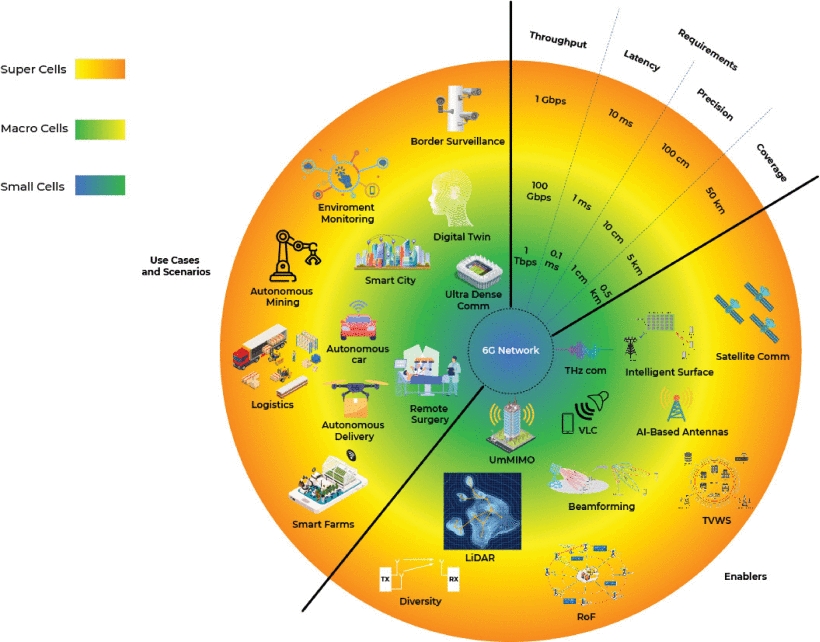
Additionally, 6G networks must accommodate a multiplicity of scenarios, applications, and services. It is obvious that a multi-radio access network (RAN) strategy will be required for the future network to handle all demands. Fig. 1 shows the primary applications, enablers, and needs that are anticipated, and arranged based on the required cell size.
Recommend News
 +86 15756287732
Contacts: Abel GU
Email: sales@shengfacn.com
Address: N3A033-N3A035, 3rd Floor, New Asia Guoli Building, No. 18 Zhonghang Road, Huahang Community, Huaqiangbei Street, Futian District, Shenzhen
-
Phone
+86 15756287732 -
WhatApp